
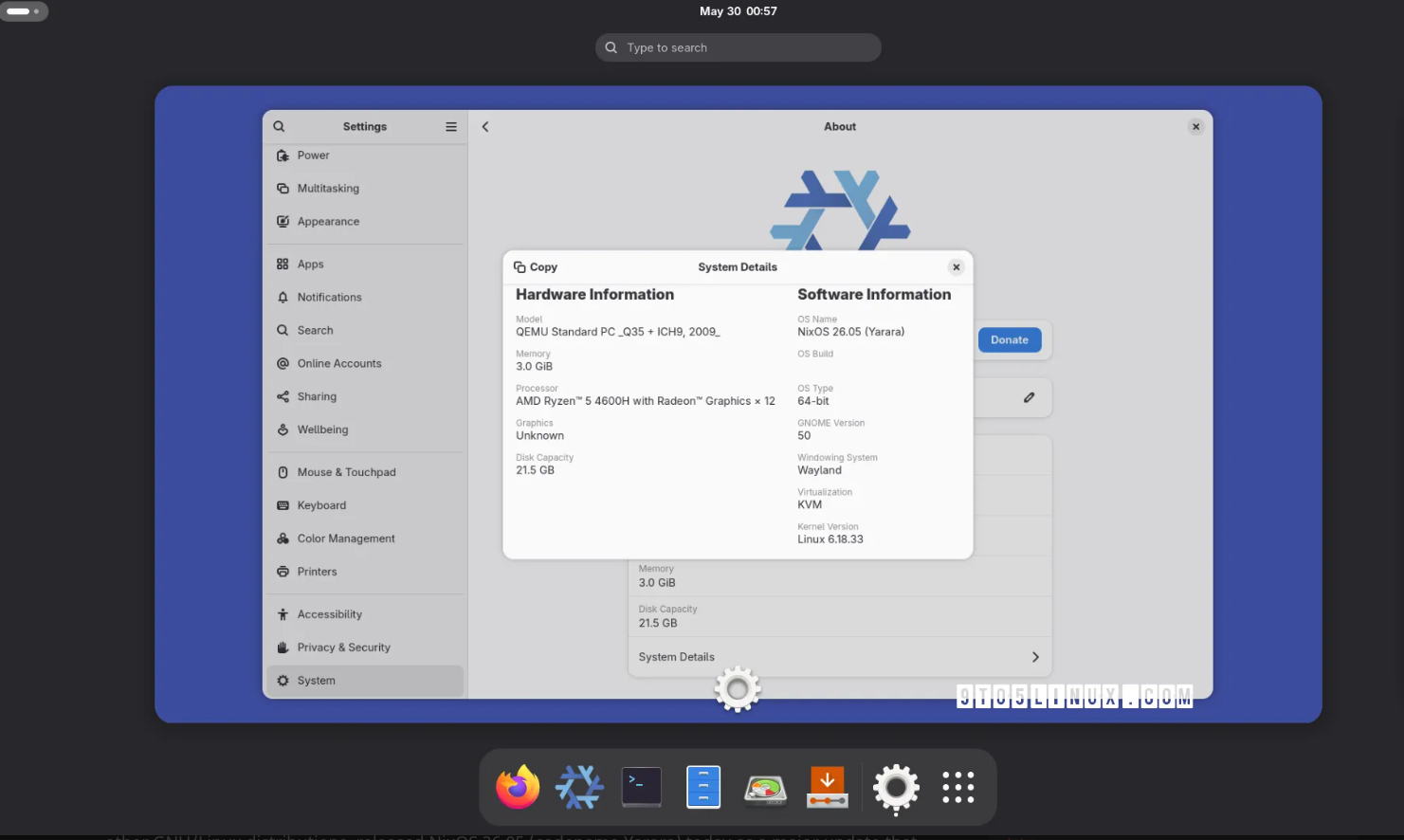
The development team behind the independent distro NixOS, whose set of packages can be used on other GNU/Linux distributions, released NixOS 26.05 (codename Yarara) today as a major update that introduces new features, improvements, and updated components.
Powered by the long-term supported Linux 6.18 LTS kernel series, NixOS 26.05 is here six months after NixOS 25.11 to introduce the latest and greatest GNOME 50 desktop environment series, systemd as the default initrd with the old scripted implementation being scheduled for removal in NixOS 26.11, and the GCC 15 compiler.
NixOS 26.05 is also the last release to support the x86_64-darwin architecture for Nixpkgs, until the end of 2026. According to the devs, NixOS 26.11 will no longer support x86_64-darwin packages due to Apple’s deprecation of the platform and limited build infrastructure.
This release also adds a system.nix file as an alternative entry point to configuration.nix and flake.nix for configuring NixOS without using nix-channel, dbus-broker as the default D-Bus implementation for higher performance and reliability, and the systemd-nspawn container as an alternative backend to QEMU VMs.
Among other noteworthy changes, NixOS 26.05 updates the NVIDIA module wiring to match the new nvidia-x11 output layout, hardens the services.calibre-web systemd service with additional sandboxing restrictions, and adds support for Bluetooth audio based on bluez-alsa to the hardware.alsa module.
Also, NixOS 26.05 adds the hardware.nvidia.branch option for selecting an NVIDIA driver branch, adds support for the Cinnamon 6.6 and Budgie 10.10 desktop environments, and adds support for configuring IPVLAN interfaces through the networking.ipvlans option in the networking module.
As usual, there are many new and updated modules and services, so check out the release announcement page for more details. Meanwhile, you can download NixOS 26.05 from the official website as live ISO images with the GNOME desktop by default for Intel/AMD (x86_64) or ARM64 (AArch64) systems, as well as a Minimal ISO flavor.
Source: 9to5 Linux
Comments (0)